Categories
Latest blog
Zero-Leak Beverage Service: How to Identify High-Quality Paper Cups?
Apr 23 , 2026A single spilled coffee due to a faulty cup costs a café much more than the price of the replacement beverage. It results in ruined clothing, a disrupted morning commute, and a permanently lost customer. When food service operators source Custom Paper Cups With Lids, the decision is frequently driven by unit cost. However, a paper cup is not a simple commodity; it is a highly engineered vessel designed to hold near-boiling, acidic liquids while being squeezed, carried, and placed in moving vehicles.
Evaluating cup quality requires looking past the visual exterior and understanding the underlying paper density, thermal barrier chemistry, and the exact mechanical tolerances of the manufacturing equipment. Relying on superficial checks often leads to procurement errors that surface only during peak operational hours. Here is the technical criteria for evaluating and sourcing high-performance paper packaging.
The structural foundation of any cup is its base paperboard, measured in Grams per Square Meter (GSM). When hot liquid is poured into a cup, the heat immediately begins to penetrate the paper fibers. If the GSM is too low for the intended volume, the cup will experience "thermal deflection"—it becomes soft, squishy, and unstable in the customer's hand.
Many overseas manufacturers attempt to reduce their production costs by shaving 10 to 20 GSM off their base paper. While this is entirely unnoticeable when the cup is empty and sitting on a warehouse shelf, it causes catastrophic structural failure during active service.
| Cup Capacity | Recommended Minimum GSM | Standard Application | Risk of Low-GSM Failure (< Recommended) |
|---|---|---|---|
| 4 oz - 8 oz | 250 - 280 GSM | Espresso, Cortado, Hot Tea | Mild sidewall softening; excessive heat transfer to fingers. |
| 10 oz - 12 oz | 300 - 320 GSM | Standard Lattes, Drip Coffee | Sidewall compression when pressure is applied to snap the lid on. |
| 16 oz - 20 oz | 320 - 350 GSM | Large Hot Beverages, Soups | Severe base deformation; high risk of vertical collapse during transit. |
| Cold Cups (All Sizes) | 250 - 300 GSM | Iced Coffee, Sodas, Smoothies | Condensation causes rapid external fiber breakdown (sweating). |
To test the rigidity of a factory sample, perform a standard operational compression test: fill the cup with 90°C (194°F) water, let it stand for exactly 10 minutes, and apply firm pressure with your thumb and index finger two inches below the rim. A high-quality cup will maintain rigid resistance, whereas a low-GSM cup will yield inward.
Data indicates that approximately 85% of all paper cup leaks occur at the bottom seam. This critical area, technically known as the knurl, is where the cylindrical sidewall meets the circular base disc. The engineering here must be flawless.
In high-quality manufacturing, the bottom edge of the sidewall is folded under the base disc, heated, and subjected to immense mechanical pressure via an ultrasonic sealing machine to create a watertight bond. If the sealing head on the factory floor is misaligned by even a fraction of a millimeter, or if the machinery operates at the wrong temperature, microscopic channels are left in the seal.
A cup's resistance to leaking from the top is entirely dependent on the geometry of its rim. The rim is created by tightly curling the top edge of the raw paper outward. This serves two critical structural purposes: it provides a smooth, comfortable surface for drinking, and it creates the precise anchoring point for the lid.
A poorly manufactured rim will feel slightly loose, easily unrolled, or spongy. When you pinch it, it may flatten out. If the rim flattens, it compromises the perfect circular geometry of the cup opening.
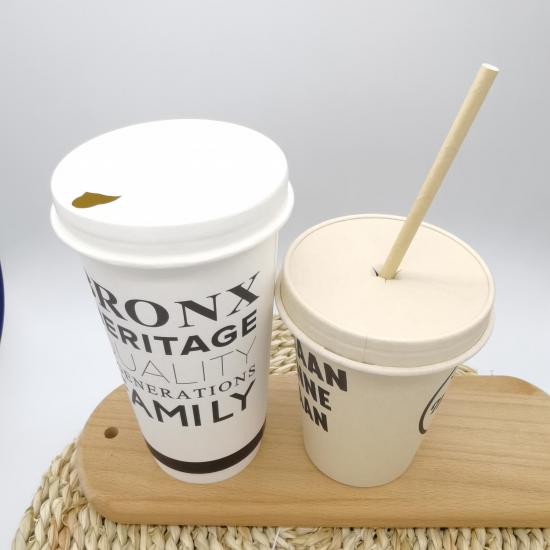
This manufacturing tolerance is exceptionally important when modernizing your inventory to meet sustainability goals. As the food service industry moves away from flexible, petroleum-based plastics, operators are transitioning to Biodegradable Paper Cup Lids made from molded pulp or high-density paperboard. Because these sustainable lids are highly rigid and do not stretch or yield like plastic, the cup's rim must be manufactured with extreme precision (typically requiring a tolerance of ±0.3mm). If the rim is too thick, the lid will not seat; if it is too thin, the lid will fail to create the watertight friction seal necessary to prevent spills during walking or driving.
Raw paper absorbs liquid instantly. The performance of any cup relies entirely on its interior barrier coating. Historically, this was achieved using a thick layer of Polyethylene (PE) plastic. Today, high performance Eco Friendly Paper Cups utilize advanced, plant-based, or water-based barrier chemistries that match the structural performance of traditional plastics without the environmental toll.
The method of application matters just as much as the raw material. Premium cups utilize an extrusion coating process that forces the barrier material deep into the microscopic pores of the paperboard, rather than just laying a fragile film on top of the surface.
| Coating Technology | Max Liquid Temperature | Barrier Adhesion Type | Performance Characteristics |
|---|---|---|---|
| Standard PE (Polyethylene) | 100°C (212°F) | Surface Level Film | Traps heat efficiently, highly water-resistant, but renders the cup non-recyclable in standard municipal facilities. |
| PLA (Polylactic Acid) | 85°C (185°F) | Surface Level Film | Excellent for warm drinks and cold beverages. Derived from corn starch. Can begin to soften or deform if exposed to boiling water for extended periods. |
| Aqueous (Water-Based) | 100°C+ (212°F+) | Deep Fiber Penetration | The barrier dries directly into the paper fibers. Impossible to peel or delaminate. Provides maximum heat stability and is fully recyclable and compostable. |
Water-based (aqueous) coatings currently represent the highest tier of cup manufacturing. Because the polymer particles dry inside the paper matrix itself, the coating cannot bubble, peel, or separate from the paperboard, even when holding boiling water for over an hour.
A frequent and damaging defect in lower-tier paper cups is the presence of an unpleasant "cardboard," dusty, or chemical taste that transfers directly into the beverage. Coffee is highly acidic and acts as a mild solvent. When a 90°C liquid hits the inside of a cup, it will extract and vaporize any residual chemicals or dust present in the paper.
This defect typically stems from using mixed-recycled pulp or employing improper factory curing times. High-quality cups are strictly manufactured from 100% virgin, food-grade wood pulp. This ensures the paper fibers are clean, pH-neutral, and free of any recycled contaminants that could alter the delicate flavor profile of specialty coffees or teas. Furthermore, premium manufacturers use rigorous off-gassing protocols and high-heat drying tunnels during production to ensure no residual moisture or manufacturing odors are trapped when the cups are tightly nested into plastic shipping sleeves.






Xiamen GLAMAN environmental technology Co., Ltd




 Phone : +86 18759299872
 Email : zheng@glamanpaperlid.com